
Last Sunday’s story from Genesis told of three visitors arrive at the tent where Abraham and Sarah have made their home under the shade of a tree in Mamre. They bring news from the Lord. Abraham and Sarah will have a son. This is very good news. This is long-awaited news. This is expected news.
Or maybe it isn’t expected news, because as the story continues, Sarah overhears the conversation as she prepares bread inside the tent. And she laughs.
The story behind Sarah’s laughter is an ancient one. It began with the promises made to Sarah and her husband, Abraham, twenty-four years earlier, back when they were living in up north, in Haran. “You will be blessed and you will have the land of Canaan,” God promised. “You will have many descendants, as many as the stars in the sky.”
It was, perhaps, a promise that seemed farfetched. She was too old to have children, even then. Now 25 years have slipped by. They have journeyed from Haran to various places in the land of Canaan. They’ve even been down to Egypt and back. Sarah and Abraham have built a life for themselves.
The scriptures indicate that their trust did waver from time to time, when doubt began to slip in.
In Chapter 15 of Genesis, Abraham, believing that he would have no legal heir, proposes that he makes his chief servant Eliezer his heir. “No, no, no,” says God, “that is not the plan I have for you.”
In Chapter 16, Sarah, believing that she would never conceive and give birth to a child, comes up with the ill-fated plan for her husband to produce his heir with her maid Hagar. “No, no” says God, “this is not the plan I have for you.”
Yet, Sarah and Abraham are faithful. They keep returning to and acting upon the covenantal promises of God. And year after year, and decade after decade, they had no child.
Now Sarah is almost 90 years old. She lives in a culture in which a woman’s value and worth are contingent upon her ability to marry and produce an heir. Sarah’s inability to have a child, her “barrenness” as the Bible puts it, has created an uncertain future. The promises of the Covenant established by God are uncertain. How can Abraham and Sarah have many descendants if they can’t even have one child?
The many people whose lives are intertwined with Abraham and Sarah’s face an uncertain future. There is a whole community of people whose lives are built around Abraham’s prosperity: slaves and servants and their families. If Abraham dies without an heir, what will happen to them? Will they become divided and scattered? All Sarah had to do was produce just one single male child in order to assure their future. I have to wonder what they thought of her. Was she a disappointment? Did they look at her and think that she was not enough of a woman? That she was too old and now worthless?
At this critical moment, the three visitors arrive.
The three visitors are no ordinary men. It is soon apparent that they know things that ordinary strangers would not know. They are angels of the Lord, stopping by Abraham and Sarah’s tent to deliver some good news. Finally. Finally, they will have that child that was promised to them so very long ago.
And Sarah laughed at the news given to a woman that was both too old and not enough.
Back in May, a Canadian athlete named Stephanie Case entered the Ultra-Trail Snowdonia race in Northern Wales — this is a 100-kilometer (62 miles!) ultramarathon across mountainous terrain.
Stephanie didn’t expect to do particularly well. Neither did anyone else, I suppose. She had run competitively for years, but had taken a three-year break, dealing with the grief of infertility, multiple miscarriages and IVF failures.
She had lost her competiton ranking, so she was placed at the back of the pack, starting 30 minutes behind the elite runners, unaware of how her time would compare.
She was 42 – old for a competitive ultrarunner. And she was six-months post-partum having finally given birth to her daughter Pepper with the help of IVF.
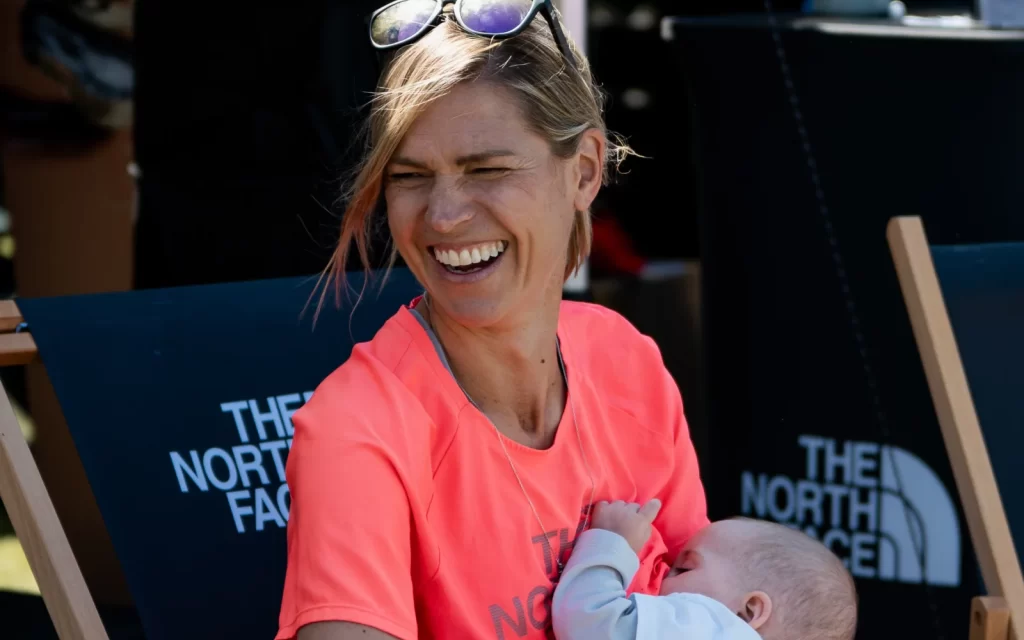
During the race, Stephanie stopped three times—but not for water or medical aid. Three times, she stopped, sat down, took her baby from her partner’s arms, and breast-fed her daughter, before standing up and starting again. Photos of her sitting on the side of the trail, grinning and cradling Pepper in her arms, bib still pinned to her racing gear, quickly spread online. Three times, her breaks were added to her total race time.
The odds were stacked against Stephanie for a strong finish. Her goal wasn’t the podium—it was participation. Joy. Movement. Wholeness.
And then, 16 hours and 53 minutes later, she crossed the finish line.
It wasn’t until race officials reviewed her tracking chip that the truth emerged: Stephanie Case, a new mom in her early 40s who had paused three times to nurse her child while the clock was ticking, had placed first among more than 60 female competitors.
“Well, that was a surprise” she posted on Instagram. “I WON?!?” She also posted a photo of herself holding Pepper and laughing, her eyes crinkled up and her mouth in a broad grin born from surprise and delight.
And that’s where this story meets the other, far older one.
In Genesis 18, the Lord appears to Abraham and tells him that his wife Sarah—now in her 90s—will bear a son. Sarah laughs. Not out loud, but inwardly. The kind of laugh that comes from deep weariness and long disappointment. It’s a laugh that says, “I used to hope for that. I don’t anymore.”
But God hears her laugh—and responds with a question: “Is anything too wonderful for the Lord?”
And Sarah, like Stephanie, ends up surprised by joy. Isaac is born—his name literally means “laughter.” And Sarah says, “God has brought me laughter, and everyone who hears about this will laugh with me.” (Gen 21:6).
Stephanie’s story reminds us: sometimes we are running on empty, just trying to show up. We’ve gone through loss and grief. We’ve let go of expectations. And then, unexpectedly, we find ourselves laughing. Not because everything is easy—but because something wonderful has broken through.
Neither woman expected the delight that awaited them. Neither fit the image we typically attach to such achievements. Stephanie wasn’t trying to win. Sarah wasn’t trying to believe. But joy caught them off guard.
Their stories remind us that delight often arrives when we least expect it—not in moments of striving, but in moments of surrender, honesty, and grace. They also remind us that identity is not fixed in the past; it’s rediscovered in movement, in openness to what God might still be doing.
Each of us has our own kind of long race to run, but don’t be surprised if joy finds you when you thought it was long gone. Because sometimes, like Sarah, we laugh. And sometimes, like Stephanie, we win.